TB Doctor in Varanasi: Complete Tuberculosis Treatment Guide (2026)
Tuberculosis remains one of India’s biggest public health challenges, and Uttar Pradesh accounts for nearly 20% of the country’s total TB burden. If you are searching for a trusted TB doctor in Varanasi, you are taking the right first step — because early diagnosis and complete treatment can fully cure tuberculosis.
At Samaria Multi-Speciality & Chest Centre, we have treated thousands of TB patients from Varanasi, Chandauli, Mirzapur, Ghazipur, and Jaunpur over the past three decades. This complete guide explains TB symptoms, diagnostic tests, DOTS treatment protocol, MDR-TB care, free government TB schemes, and how to choose the right TB specialist for full recovery.
TB Burden in Varanasi & Uttar Pradesh
According to the India TB Report 2024, Uttar Pradesh notified over 6.4 lakh TB cases — the highest among all states. Varanasi district alone reports several thousand cases every year. The high burden is driven by a combination of factors:
- High population density in localities like Madanpura, Bhelupur, Lallapura, and the inner-city ghats area
- Poor ventilation in older mohallas with narrow lanes
- Malnutrition — a major risk factor for TB activation
- Diabetes co-infection — UP has rising diabetes rates, which triple TB risk
- Tobacco use — smoking and chewing tobacco weaken lung defences
- HIV co-infection — though smaller in number, significantly increases TB susceptibility
The good news? India has set a goal to eliminate TB by 2025 under the Pradhan Mantri TB Mukt Bharat Abhiyan, and Varanasi has seen a steady increase in case detection and treatment success rates over the last 5 years. Working with a qualified TB specialist in Varanasi dramatically improves your chances of full cure.
Types of Tuberculosis
Many people think TB only affects the lungs, but it can affect almost any organ. Understanding the type helps your TB doctor in Varanasi choose the right treatment plan.
1. Pulmonary TB (PTB)
The most common type — affects the lungs. About 80% of TB cases in Varanasi are pulmonary TB. This is the form that spreads from person to person through coughing.
2. Extra-Pulmonary TB (EPTB)
TB outside the lungs. It can affect:
- Lymph nodes (TB lymphadenitis — common in neck)
- Bones and joints (Pott’s spine, TB arthritis)
- Brain and spine (TB meningitis — an emergency)
- Abdomen (intestinal and peritoneal TB)
- Genitourinary system (kidneys, bladder, reproductive organs)
- Pleura (TB pleural effusion — fluid around lungs)
Extra-pulmonary TB does not spread to others but needs the same TB drug regimen.
3. MDR-TB (Multi-Drug Resistant TB)
TB that does not respond to the two most powerful first-line drugs — isoniazid and rifampicin. Requires longer treatment with second-line drugs.
4. XDR-TB (Extensively Drug Resistant TB)
The most severe form — resistant to first-line and second-line drugs. Treated with newer drugs like Bedaquiline and Delamanid under specialist supervision.
5. Latent TB Infection (LTBI)
The TB bacteria are present in the body but inactive. The person is not sick and cannot spread TB. However, latent TB can become active later, especially in people with weak immunity. Identifying and treating latent TB is part of India’s elimination strategy.
TB Symptoms — The 2-Week Cough Rule
The single most important rule: any cough lasting more than 2 weeks should be evaluated for TB. This simple rule can save thousands of lives in Varanasi every year.
Common Symptoms of Pulmonary TB
- Persistent cough — more than 2 weeks, often producing mucus, sometimes with blood
- Low-grade fever — especially in the evening or at night
- Night sweats — soaking the clothes or pillow
- Unexplained weight loss — losing weight without trying
- Loss of appetite — not feeling hungry, food tasting bland
- Fatigue and weakness — feeling drained even after rest
- Chest pain — especially with deep breathing or coughing
- Hemoptysis — coughing up blood (a serious warning sign)
- Shortness of breath — in advanced cases
Symptoms of Extra-Pulmonary TB
Vary by site — swollen neck lymph nodes, persistent back pain, abdominal swelling, blood in urine, or unexplained joint pain. If accompanied by fever and weight loss, always rule out TB.
If you or your family member has any of these symptoms, do not self-medicate or rely on antibiotics from a chemist. Visit a qualified chest doctor in Varanasi for proper evaluation.
How TB Spreads — Myths vs Facts
Stigma and misinformation are major barriers to TB control in Varanasi. Let’s clear the most common myths:
| Myth | Fact |
|---|---|
| TB spreads by sharing utensils or food | FALSE. TB spreads only through air, when an infected person coughs, sneezes, or spits. |
| TB is hereditary | FALSE. TB is an infectious disease caused by bacteria, not passed through genes. |
| TB always causes death | FALSE. TB is fully curable with proper 6-month treatment. |
| Once cured, TB cannot return | PARTIALLY TRUE. Re-infection is possible if exposed again, especially in low immunity. |
| Only poor people get TB | FALSE. TB affects all socioeconomic classes — though poverty and malnutrition increase risk. |
| TB patients should be isolated forever | FALSE. After 2 weeks of effective treatment, most patients are no longer infectious and can return to normal life. |
| TB is a curse or punishment | FALSE. TB is a medical condition caused by Mycobacterium tuberculosis — nothing more. |
Removing this stigma is half the battle won. Talk openly with your TB doctor in Varanasi — complete confidentiality is maintained at our clinic.
TB Diagnostic Tests at Samaria Chest Centre
Modern TB diagnosis goes far beyond the old chest X-ray approach. We follow current Standards for TB Care in India (STCI) guidelines:
1. Sputum AFB Smear Microscopy
Two sputum samples are examined under microscope for acid-fast bacilli. It is the simplest and cheapest test, available free at all DMCs in Varanasi.
2. GeneXpert / CBNAAT (Cartridge-Based Nucleic Acid Amplification Test)
The recommended first-line TB test today. It detects TB DNA and rifampicin resistance simultaneously, with results in just 2 hours. Highly sensitive even when sputum has very few bacteria.
3. Chest X-Ray
Helpful for screening and assessing the extent of lung damage. Often shows characteristic upper-lobe shadows, cavities, or pleural effusion.
4. CT Chest (HRCT)
For complex cases — distinguishes TB from cancer, fungal infections, and ILD. Especially useful in extra-pulmonary and post-TB sequelae cases.
5. Drug Susceptibility Testing (DST)
Liquid culture (BACTEC MGIT) and Line Probe Assay determine which drugs the TB bacteria will respond to — critical for MDR-TB and XDR-TB treatment planning.
6. Bronchoscopy
For patients who cannot produce sputum, our interventional pulmonologist Dr. Kumar Utsav performs flexible bronchoscopy with bronchoalveolar lavage (BAL) to obtain samples directly from the lungs.
7. Mantoux / Tuberculin Skin Test (TST) and IGRA
Used mainly for diagnosing latent TB infection, especially in contacts of active TB patients and immunocompromised individuals.
DOTS Treatment Protocol Explained
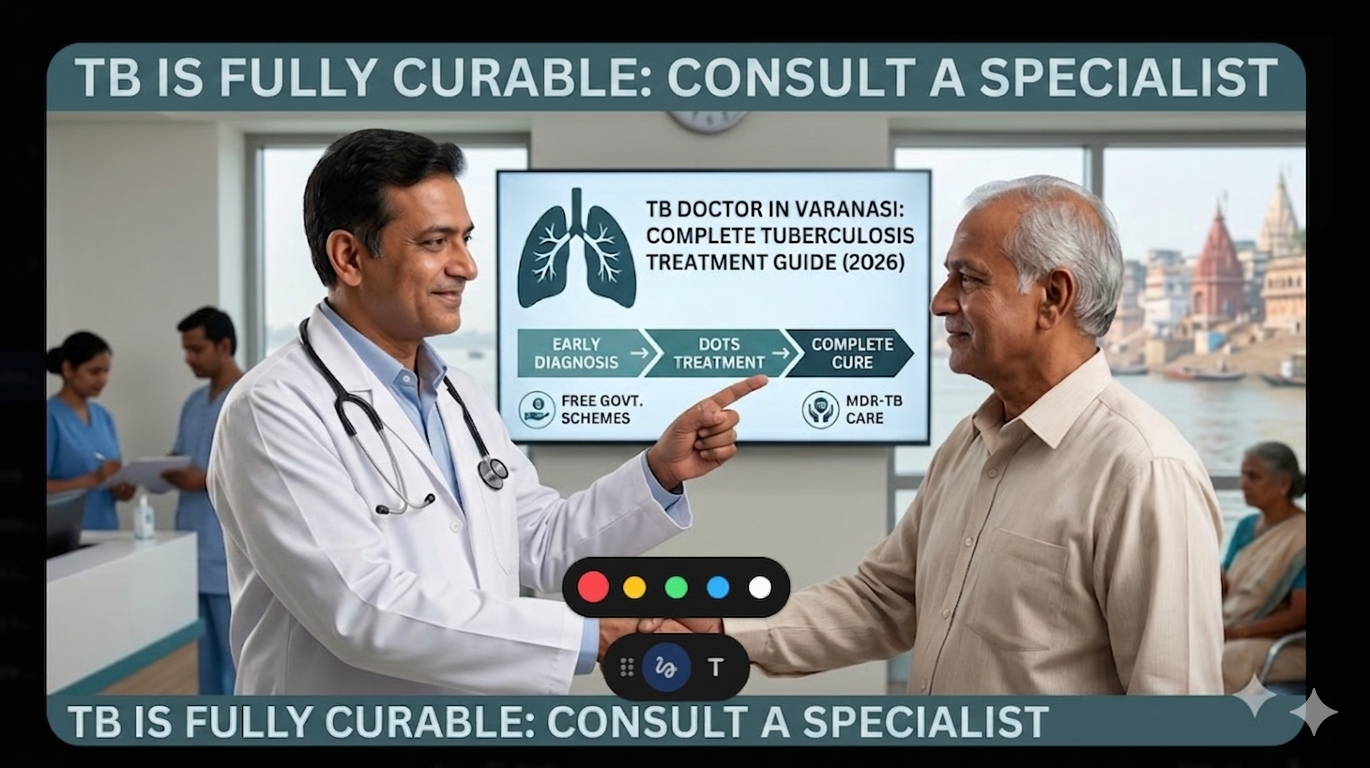
DOTS stands for Directly Observed Treatment, Short-course — the WHO-recommended TB treatment strategy followed across India. Under DOTS, a trained provider observes the patient swallow each dose, ensuring no medicine is missed.
Standard 6-Month TB Regimen (Drug-Sensitive TB)
Intensive Phase (2 months): Four drugs — Isoniazid (H), Rifampicin (R), Pyrazinamide (Z), Ethambutol (E).
Continuation Phase (4 months): Two drugs — Isoniazid (H) and Rifampicin (R).
Total duration: 6 months. Today, daily fixed-dose combinations (FDCs) have replaced the older alternate-day regimen for better outcomes.
Why You Must Complete Full Treatment
This is critical: many patients stop medicines after 2 months because they feel better. This is the single biggest cause of MDR-TB in Varanasi. The bacteria are not fully killed and become resistant. Always complete the full course, even if you feel completely fine.
Side Effects to Watch For
- Yellowing of eyes/skin (jaundice) — report immediately
- Numbness or tingling in feet (vitamin B6 deficiency)
- Vision changes (caused by Ethambutol)
- Joint pain (caused by Pyrazinamide)
- Skin rashes or itching
- Reddish-orange urine (normal with Rifampicin — not harmful)
Most side effects are manageable. Never stop medicines on your own — always consult your TB doctor in Varanasi first.
MDR-TB and XDR-TB — Drug-Resistant Tuberculosis
India unfortunately has one of the highest MDR-TB burdens globally. At Samaria Chest Centre, we follow the latest WHO guidelines for shorter, all-oral MDR-TB regimens that have transformed treatment outcomes.
BPaL and BPaLM Regimens (Latest)
The newer 6-month all-oral regimen using Bedaquiline, Pretomanid, Linezolid (and Moxifloxacin) has revolutionised MDR-TB care — replacing the older 18–24 month painful injection-based regimens. Cure rates now exceed 89%.
Long-Term MDR-TB Regimens
For patients who cannot take BPaL, individualised 9–18 month regimens with drugs like Linezolid, Cycloserine, Clofazimine, and Levofloxacin are designed based on drug susceptibility testing.
If you have been on TB treatment but are not improving, or if anyone in your contact has MDR-TB, urgent evaluation by an experienced TB specialist in Varanasi is essential.
Diet & Lifestyle During TB Treatment
Nutrition is half the cure in TB. Most TB patients in Varanasi are underweight at diagnosis, and proper diet dramatically improves recovery and reduces relapse.
Recommended TB Diet (High-Calorie, High-Protein)
- Dairy: Milk, paneer, curd, ghee — 2-3 servings daily
- Pulses & legumes: Chana, moong, masoor, rajma — daily
- Eggs: 2 boiled eggs daily (if non-vegetarian)
- Meat & fish: Chicken, mutton, fish — 3-4 times a week
- Sattu & chana: Excellent local Varanasi source of cheap protein
- Nuts & seeds: Almonds, walnuts, peanuts
- Seasonal fruits: Banana, papaya, guava, orange, mango
- Green vegetables: Spinach, methi, sarson saag
- Whole grains: Wheat, jowar, bajra rotis
- Jaggery (gur): Better than sugar — rich in iron
Foods to Avoid
- Alcohol — causes severe liver damage with TB drugs
- Tobacco in any form (cigarette, beedi, gutka)
- Excess oily, fried, processed foods
- Aerated drinks and high-sugar items
Lifestyle Tips
- Sleep 8 hours daily
- Light walking once you feel better — no heavy gym
- Open windows for cross-ventilation in your room
- Cover mouth while coughing for the first 2 weeks
- Use a separate room and utensils briefly during the infectious period
- Get family members screened (contact tracing)
Free TB Treatment Schemes in Varanasi
India offers some of the most generous TB programmes in the world. Every TB patient in Varanasi is entitled to:
1. Free TB Diagnosis & Medicines
Complete TB testing (sputum, GeneXpert, X-ray) and full medicine course is free under the National TB Elimination Programme (NTEP) at all government DMCs and Tuberculosis Units (TUs) in Varanasi.
2. Ni-kshay Poshan Yojana
Every notified TB patient receives Rs. 1000 per month as nutrition support directly into their bank account through DBT, throughout the treatment duration.
3. Ni-kshay Mitra Initiative
Patients can be adopted by community Ni-kshay Mitras who provide additional nutritional and emotional support — a unique community-driven programme launched under PM TB Mukt Bharat Abhiyan.
4. Travel Reimbursement & Honorarium
Tribal and remote-area TB patients receive transport allowance for treatment visits.
At Samaria Chest Centre, we help every patient register on the Ni-kshay portal and access these government benefits, even if they choose to take treatment privately for additional comfort.
Why Choose Samaria as Your TB Doctor in Varanasi
- 30+ Years of TB Expertise: Dr. J.K. Samaria has treated thousands of TB and MDR-TB patients across Eastern UP.
- Former Head of Chest Diseases, IMS BHU: Trusted name in respiratory medicine in Varanasi.
- Complete TB Workup Under One Roof: X-ray, sputum testing, GeneXpert access, and bronchoscopy.
- MDR-TB & XDR-TB Management: Advanced treatment with newer drugs like Bedaquiline.
- NTEP Linkage: We help you avail all free government benefits while ensuring quality private care.
- Strict Confidentiality: No stigma. Complete privacy guaranteed.
- Family Contact Screening: Free screening for your household members.
- Telephonic Follow-Up: Regular monitoring even after treatment completion.
- Convenient Durgakund Location: Easy access from BHU, Lanka, Sigra, Bhelupur.
Frequently Asked Questions
Q1. Who is the best TB doctor in Varanasi?
Dr. J.K. Samaria, Senior Consultant Pulmonologist at Samaria Multi-Speciality & Chest Centre, Durgakund, is one of the most trusted TB doctors in Varanasi with over 30 years of experience and former Head of Chest Diseases at IMS BHU.
Q2. Is TB treatment free in Varanasi?
Yes. Under NTEP, complete TB diagnosis and treatment is free at all government facilities and DMCs. Patients also receive Rs. 1000 per month nutrition support under Ni-kshay Poshan Yojana.
Q3. How long does TB treatment take?
Standard drug-sensitive TB treatment takes 6 months. MDR-TB takes 9-18 months, and XDR-TB may need 18-24 months of supervised therapy.
Q4. What are the first symptoms of TB?
Cough lasting more than 2 weeks, low-grade evening fever, night sweats, unexplained weight loss, loss of appetite, and fatigue. Seek medical evaluation immediately.
Q5. Is TB completely curable?
Yes. Drug-sensitive TB has over 95% cure rate. Even MDR-TB and XDR-TB are curable today with newer drugs and longer regimens.
Q6. Can I get TB from a family member?
TB spreads through airborne droplets. Close household contact does increase risk, but with prompt treatment and basic precautions, family transmission can be largely prevented.
Q7. Where can I get a TB test in Varanasi?
TB testing is available at Samaria Chest Centre, Durgakund, all government DMCs, and BHU Hospital. GeneXpert provides results in 2 hours.
Q8. Can a TB patient go to work or school?
After 2 weeks of effective treatment, most pulmonary TB patients are no longer infectious and can resume normal activities. Extra-pulmonary TB is not infectious from the start.
Q9. Why do some patients get TB twice?
Re-infection happens if exposed again, especially with low immunity (diabetes, malnutrition, HIV). Reactivation of latent TB is also possible. Both are preventable with healthy lifestyle and prompt treatment.
Q10. Should family members be tested for TB?
Yes. All household contacts — especially children, elderly, diabetics, and pregnant women — should be screened. We offer free contact screening at Samaria Chest Centre.
Take Charge of Your Lung Health Today
Tuberculosis is one of the few serious diseases that is 100% curable with proper diagnosis and complete treatment. Yet thousands of Varanasi residents delay testing because of fear, stigma, or misinformation — allowing the disease to spread and worsen.
If you or someone in your family has had a cough for more than 2 weeks, persistent fever, or unexplained weight loss, do not wait. Book a confidential consultation with our experienced TB doctors at Samaria Multi-Speciality & Chest Centre. With the right care, you can be back to full health in 6 months.
Related Reading
Medical Disclaimer: This article is for general informational purposes only and is not a substitute for professional medical advice, diagnosis, or treatment. Always consult a qualified TB doctor or chest specialist for any health concerns.